Get started with Chkk for free today! No credit card required
Learn more
Learn more
Back to the blog
News
April 25, 2025

Google Container Registry Deprecation 2025: How to Migrate to Artifact Registry

Written by
Chkk Team
X logoLinkedin logo
Start for free
Estimated Reading time
2 min

If you're managing containerized workloads on GCP, it's time to start planning for a key infrastructure change: Google Cloud has officially announced the deprecation of Container Registry (GCR), with a full shutdown planned for 2025. This represents a complete transition to Artifact Registry, Google Cloud’s new container image and artifact management service. As organizations increasingly rely on containers, proactively migrating to Artifact Registry will ensure seamless operations and enable you to leverage enhanced capabilities.

This blog provides an in-depth look at why GCR is being deprecated, highlights the critical Container Registry deprecation timeline, and offers a comprehensive migration plan. We'll explore the differences between GCR and Artifact Registry, along with practical steps to achieve a seamless, zero-downtime migration.

Key Deprecation Dates

Migrating off GCR is time-sensitive. Google has published a phased Container Registry deprecation timeline, giving users ample time (until 2025) to transition. Below are the key dates and what happens at each milestone:

  • March 18, 2025: gcr.io write‑only endpoints are disabled – pushes fail
  • May 20, 2025: Read traffic to Container Registry buckets is cut off – pulls fail
  • July 17, 2025: If a gcr.io repository has been created in Artifact Registry, all gcr.io/* references are transparently served by Artifact Registry; images left behind in GCR buckets become inaccessible

In summary, by mid-2025 GCR will no longer function at all. You should aim to migrate from GCR to Artifact Registry well before the pull shutdown in May 2025 to avoid any risk.

Why Google is Deprecating GCR

Container Registry launched in 2015 as a convenience layer on top of multi‑regional Cloud Storage buckets. The industry (and CNCF) has since standardized on the OCI Distribution Specification, driving expectations around:

  • Repository‑scoped IAM rather than bucket‑wide ACLs
  • Regional hosting + VPC‑SC to reduce egress and satisfy data‑sovereignty rules
  • Built‑in SBOM & vulnerability scanning that covers both OS layers and language packages
  • Virtual / remote repositories for deterministic dependency caching and provenance
  • First‑class integrations with Cloud Build, Cloud Run, GKE Autopilot, and Binary Authorization.

Artifact Registry ships all of the above while remaining API‑compatible with OCI clients (e.g. docker, nerdctl, crane).
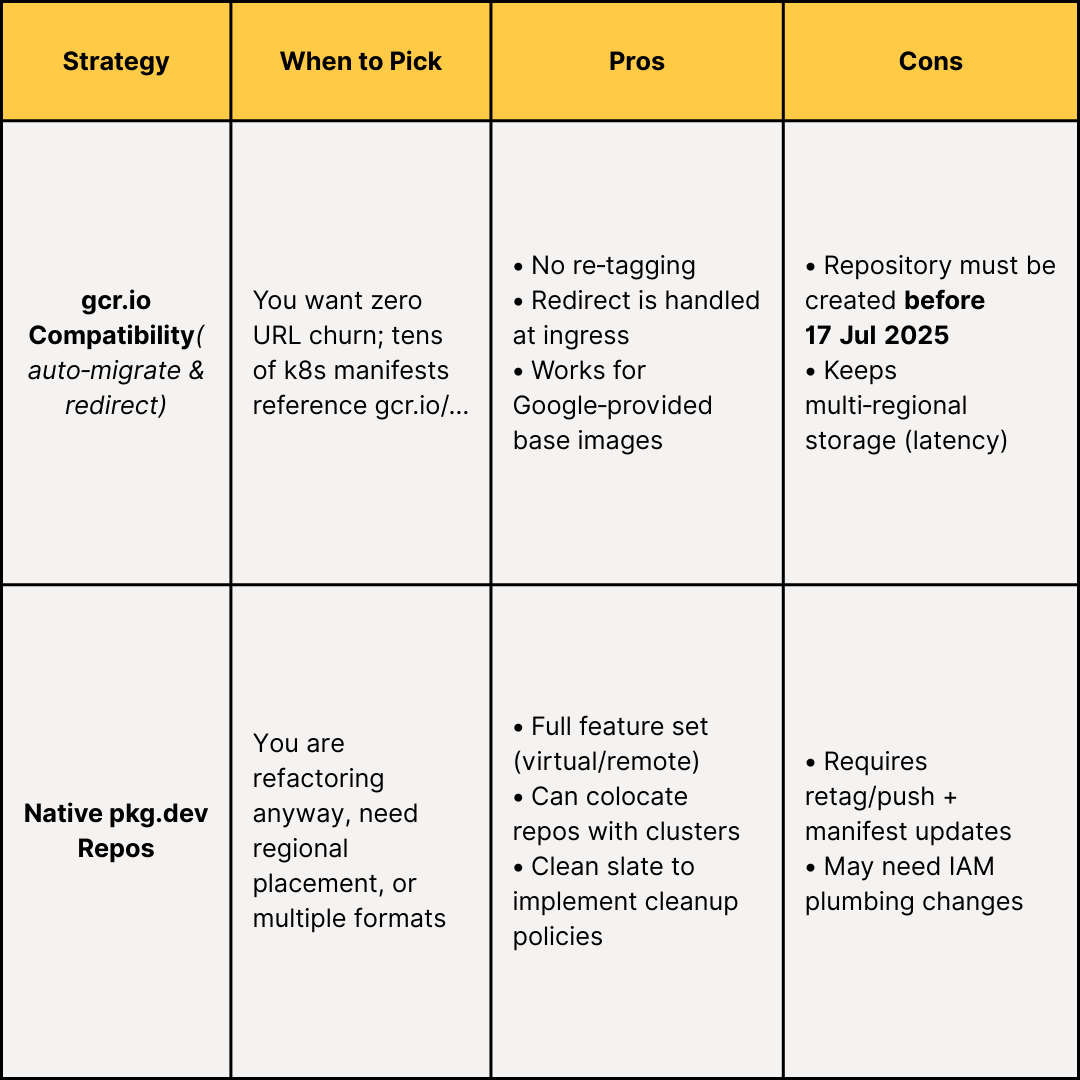
Selecting Your Migration Strategy

Tip: You can mix both. Many teams stand up a us-docker.pkg.dev repo for new workloads while enabling gcr.io redirection for legacy pipelines.

Don't Delay: Act Now to Avoid Disruption

The deadline for the Google container images shutdown is fast approaching. It's crucial to start your migration to Artifact Registry today to avoid any potential service disruptions. By transitioning early, you not only ensure continued access to your container images but also gain access to the enhanced security, scalability, and management features offered by Artifact Registry.

For detailed guidance and step-by-step instructions, be sure to visit the official Google Cloud documentation on transitioning from Container Registry. Don't wait until the last minute – take charge of your container image strategy by moving to Google Cloud Artifact Registry today.

If you're managing containerized workloads on GCP, it's time to start planning for a key infrastructure change: Google Cloud has officially announced the deprecation of Container Registry (GCR), with a full shutdown planned for 2025. This represents a complete transition to Artifact Registry, Google Cloud’s new container image and artifact management service. As organizations increasingly rely on containers, proactively migrating to Artifact Registry will ensure seamless operations and enable you to leverage enhanced capabilities.

This blog provides an in-depth look at why GCR is being deprecated, highlights the critical Container Registry deprecation timeline, and offers a comprehensive migration plan. We'll explore the differences between GCR and Artifact Registry, along with practical steps to achieve a seamless, zero-downtime migration.

Key Deprecation Dates

Migrating off GCR is time-sensitive. Google has published a phased Container Registry deprecation timeline, giving users ample time (until 2025) to transition. Below are the key dates and what happens at each milestone:

  • March 18, 2025: gcr.io write‑only endpoints are disabled – pushes fail
  • May 20, 2025: Read traffic to Container Registry buckets is cut off – pulls fail
  • July 17, 2025: If a gcr.io repository has been created in Artifact Registry, all gcr.io/* references are transparently served by Artifact Registry; images left behind in GCR buckets become inaccessible

In summary, by mid-2025 GCR will no longer function at all. You should aim to migrate from GCR to Artifact Registry well before the pull shutdown in May 2025 to avoid any risk.

Why Google is Deprecating GCR

Container Registry launched in 2015 as a convenience layer on top of multi‑regional Cloud Storage buckets. The industry (and CNCF) has since standardized on the OCI Distribution Specification, driving expectations around:

  • Repository‑scoped IAM rather than bucket‑wide ACLs
  • Regional hosting + VPC‑SC to reduce egress and satisfy data‑sovereignty rules
  • Built‑in SBOM & vulnerability scanning that covers both OS layers and language packages
  • Virtual / remote repositories for deterministic dependency caching and provenance
  • First‑class integrations with Cloud Build, Cloud Run, GKE Autopilot, and Binary Authorization.

Artifact Registry ships all of the above while remaining API‑compatible with OCI clients (e.g. docker, nerdctl, crane).

Selecting Your Migration Strategy

Tip: You can mix both. Many teams stand up a us-docker.pkg.dev repo for new workloads while enabling gcr.io redirection for legacy pipelines.

Don't Delay: Act Now to Avoid Disruption

The deadline for the Google container images shutdown is fast approaching. It's crucial to start your migration to Artifact Registry today to avoid any potential service disruptions. By transitioning early, you not only ensure continued access to your container images but also gain access to the enhanced security, scalability, and management features offered by Artifact Registry.

For detailed guidance and step-by-step instructions, be sure to visit the official Google Cloud documentation on transitioning from Container Registry. Don't wait until the last minute – take charge of your container image strategy by moving to Google Cloud Artifact Registry today.

Tags
Kubernetes
Google Container Registry
Artifact Registry

Continue reading

Spotlight

Spotlight: Simplifying Contour Upgrades with Chkk

by
Chkk Team
Read more
Hidden Toil

5 Reasons Why Delaying Open Source Software Upgrades Is a Bad Idea

by
Awais Nemat
Read more
Spotlight

Spotlight: Seamless cert-manager Upgrades with Chkk

by
Chkk Team
Read more
Spotlight

Spotlight: Argo Rollouts Upgrades with Chkk

by
Chkk Team
Read more
Upgrade Advisory

Upgrade Advisory: Pods Stuck in Pending During Kubelet v1.30 → v1.31 Upgrade

by
Chkk Team
Read more
Spotlight

Spotlight: Simplifying Self-Managed Apache Kafka Upgrades with Chkk

by
Chkk Team
Read more
Spotlight

Spotlight: Seamless Calico Upgrades with Chkk

by
Chkk Team
Read more
Spotlight

Spotlight: NGINX Ingress Controller Upgrades with Chkk

by
Chkk Team
Read more
Spotlight

Spotlight: KEDA Upgrades with Chkk

by
Chkk Team
Read more
Spotlight

Spotlight: Streamlining Prometheus Upgrades with Chkk

by
Chkk Team
Read more
Spotlight

Spotlight: RabbitMQ Upgrades with Chkk

by
Chkk Team
Read more
Spotlight

Spotlight: Seamless Kyverno Upgrades with Chkk

by
Chkk Team
Read more
News

Google Container Registry Deprecation 2025: How to Migrate to Artifact Registry

by
Chkk Team
Read more
Spotlight

Spotlight: HashiCorp Vault Upgrades with Chkk

by
Chkk Team
Read more
Spotlight

Spotlight: Streamlining Crossplane Upgrades with Chkk

by
Chkk Team
Read more
Spotlight

Spotlight: Seamless External DNS Upgrades with Chkk

by
Chkk Team
Read more
Case Study

How Dexcom Derisked GKE Upgrades and Sped Them Up by 5x using Chkk

by
Chkk Team
Read more
Case Study

Assuring Compliance and Availability for Yoti’s On-Prem Platform with Chkk

by
Chkk Team
Read more
Case Study

How a Fortune 500 Enterprise Avoided $500K in EKS Extended Support Fees, Achieved 80% Reduction in Prep Time, and Boosted Upgrade Productivity by 200%

by
Chkk Team
Read more
Case Study

How a Fortune 1000 Enterprise Standardized Multi-Cloud (EKS & GKE) Upgrades for 30+ Add-Ons, Avoided 6x Costs, and Achieved an 80% Reduction in Prep Time

by
Chkk Team
Read more
Spotlight

Spotlight: Upgrading Self-Managed Redis

by
Chkk Team
Read more
Spotlight

Spotlight: Simplifying Self-Managed Elasticsearch Upgrades with Chkk

by
Chkk Team
Read more
News

GKE & EKS Extended Support: Are 6x Fees for Supporting Older Kubernetes Versions Justified?

by
Ali Khayam
Read more
Spotlight

Spotlight: Seamless Karpenter Upgrades with Chkk

by
Chkk Team
Read more
Operational Safety

Forced EKS & GKE Upgrades: How to Manage Business Continuity Risks

by
Fawad Khaliq
Read more
Spotlight

Spotlight: How Chkk Streamlines & Safeguards Cilium Upgrades

by
Chkk Team
Read more
Technology

Kubernetes Admission Controllers and Webhooks Deep Dive

by
Chkk Team
Read more
Spotlight

Chkk Spotlight: Istio

by
Chkk Team
Read more
Technology

Pod Disruption Budgets: Pitfalls, Evictions & Kubernetes Upgrades

by
Chkk Team
Read more
Technology

cgroup v1 to v2 Migration in Kubernetes

by
Chkk Team
Read more
Operational Safety

OpenAI’s Outage: The Complexity and Fragility of Modern AI Infrastructure on Kubernetes

by
Fawad Khaliq
Read more
News

EKS launches Auto Mode… How can you adopt it?

by
Ali Khayam
Read more
Change Safety

CrowdStrike outage was the symptom; missing Operational Safety was the cause

by
Fawad Khaliq
Read more
News

GKE Follows EKS & AKS, Launches Extended Support with a 500% Surcharge for Delayed Upgrade

by
Ali Khayam
Read more
News

AKS Long Term Support and EKS Extended Support: Similarities & Differences

by
Ali Khayam
Read more
News

Amazon launches EKS extended support… How does it impact you?

by
Ali Khayam
Read more
Platform Engineering

Platform teams need a delightfully different approach, not one that sucks less

by
Fawad Khaliq
Read more
Technology

Kubernetes Enters Its Second Decade: Insights from KubeCon Chicago

by
Fawad Khaliq
Read more
Company

Launching Chkk Operational Safety Platform

by
Awais Nemat
Read more
Technology

What Makes Kubernetes Upgrades So Challenging?

by
Fawad Khaliq
Read more
Company

4 Lessons from our SOC2 Journey

by
Fawad Khaliq
Read more
Technology

Collective Learning: The Power of Not Repeating Others’ Mistakes

by
Ali Khayam
Read more
Technology

From Fighting Fires to Availability Assurance

by
Fawad Khaliq
Read more
Company

Welcome to Chkk

by
Awais Nemat
Read more