Get started with Chkk for free today! No credit card required
Learn more
Learn more
Back to the blog
Spotlight
March 24, 2025

Spotlight: Upgrading Self-Managed Redis

Written by
Chkk Team
X logoLinkedin logo
Start for free
Estimated Reading time
4 min

Redis is a high-performance, in-memory key-value store commonly used for caching, session management, and real-time analytics. By supporting a variety of data structures—like strings, hashes, and sorted sets—Redis can deliver rapid data access with optional persistence to disk for durability. Its replication and clustering features help maintain high availability, while running Redis on Kubernetes offers automated lifecycle management through operators or Helm/Kustomize deployments.

However, upgrading self-managed Redis can come with challenges. Changes to persistence layers (RDB/AOF), new configuration parameters, or cluster topology tweaks may introduce risks of downtime or data loss if not addressed proactively. In this post, we’ll show you how Chkk’s Operational Safety Platform supports seamless Redis upgrades—from curated release notes and preflight checks to detailed Upgrade Templates and preverification—so you can keep your Redis clusters running reliably without the usual disruption.

Chkk’s Coverage for Redis

Curated Release Notes

Chkk continuously monitors official Redis release notes to highlight only the most critical aspects—like security fixes, breaking changes to AOF/RDB persistence, or new features that might affect your caching or replication configurations. By filtering out the noise, Chkk ensures you see the most relevant updates for your particular Redis deployments, enabling you to act quickly on urgent fixes or plan in advance for feature deprecations.

Preflight & Postflight Checks

Before upgrading Redis, Chkk runs preflight checks that look for deprecated commands, outdated parameter settings, and potential resource constraints that could cause disruption. For example, if a new version changes the default eviction policy, Chkk will flag this so you can verify settings before rolling out. After the upgrade, postflight checks confirm that replication or clustering is functioning correctly and that performance metrics remain stable. This two-step validation helps you detect and resolve issues before they reach production users.

Version Recommendations

Chkk keeps tabs on Redis’s support lifecycle to recommend stable, secure, and Kubernetes-compatible releases. If your current version is nearing End-of-Life (EOL) or missing critical patches, Chkk alerts you well in advance so you can schedule upgrades on your own timeline. This proactive approach means you’re less likely to run unmaintained or vulnerable versions of Redis in production.

Upgrade Templates

Chkk supports multiple upgrade strategies tailored to Redis:

  • In-Place Rolling Updates: Sequentially upgrade nodes or replicas in your cluster, maintaining availability for read/write operations as each node restarts.
  • Blue-Green Deployments: Spin up a parallel Redis environment, synchronize data, and cut over traffic only after the new setup has been thoroughly tested—offering near-zero downtime and a straightforward rollback if needed.

Each approach comes with a detailed, step-by-step playbook to ensure a smooth transition, complete with safety checks and rollback guidance for both minor patches and major version jumps.

Supported Packages

Whether you install Redis through Helm, Kustomize, operators, or raw Kubernetes manifests, Chkk recognizes and supports your existing tooling. This means you can continue using the workflows and repositories you’re comfortable with, all while benefiting from Chkk’s automated checks, curated release notes, and upgrade orchestration.

Chkk’s Core Benefits

Chkk Operational Safety Platform simplifies upgrades, reduces risk, and keeps your Kubernetes infrastructure operational. Here’s how that applies to Redis upgrades:
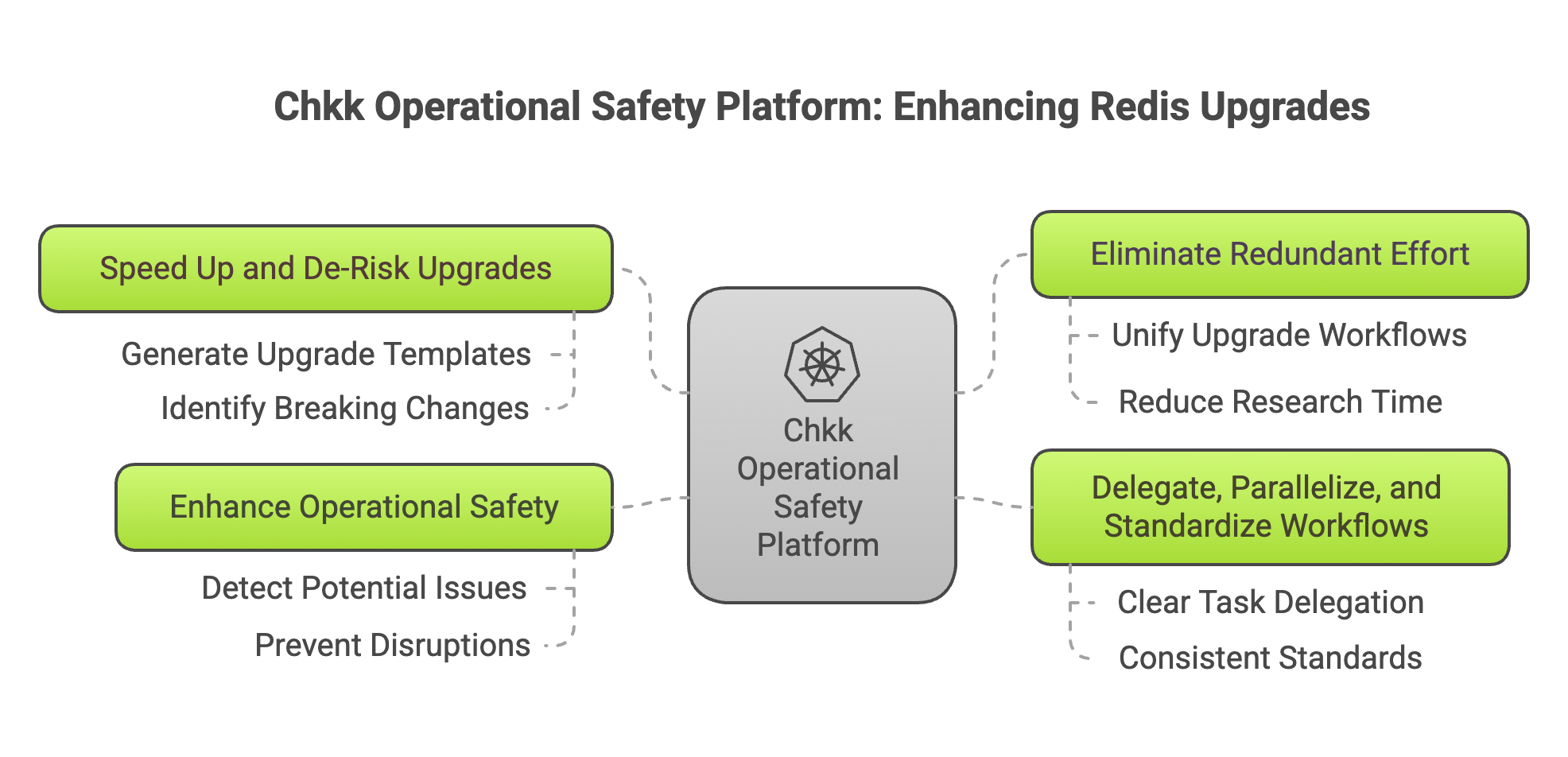
  • Speed Up and De-Risk Upgrades: Manually upgrading Redis is time-consuming. Chkk accelerates the process and makes it safer by generating a detailed Upgrade Plan for each cluster. This plan spans all components—control plane, node versions, add-ons, and dependencies—and flags required changes, including recommended add-on versions or deprecated APIs. Instead of piecing together requirements from various release notes, teams receive a clear and actionable upgrade path. Chkk’s automation can cut upgrade preparation time by 3–5x, reducing weeks of planning to just days.
  • Eliminate Redundant Effort: Many organizations squander countless hours on repetitive upgrade planning and research. By unifying upgrade workflows across teams, Chkk prevents duplication of effort and ensures that insights and processes don’t need to be reinvented with every release. This consolidation of efforts can save thousands of hours.
  • Delegate, Parallelize, and Standardize Workflows: Chkk makes it easy to break out upgrade tasks among team members, all while maintaining standardized workflows that reduce confusion and boost efficiency. Engineers spend less time context-switching, and institutional knowledge is retained and shared effectively. During staff turnover or organizational changes, having a historical record of upgrade best practices prevents delays.
  • Enhance Operational Safety: Kubernetes upgrades introduce inherent risk, but Chkk helps you detect and fix potential problems before they cause disruptions. With automated risk detection, your team can prevent hundreds of potential breakages annually—for every hundred clusters—saving significant break-fix effort. By focusing on proactive measures, you can innovate rather than constantly firefighting.
An infographic showing Chkk Operational Safety Platform benefits

Simplify Upgrades for 100s of Add-ons and Kubernetes Clusters

Try Chkk Upgrade Copilot to experience how these extended capabilities can simplify your upgrade processes for Redis and 100s of other Kubernetes add-ons. We look forward to helping you achieve seamless, secure, and efficient operations.

Click the button below to book a demo and learn more.

Redis is a high-performance, in-memory key-value store commonly used for caching, session management, and real-time analytics. By supporting a variety of data structures—like strings, hashes, and sorted sets—Redis can deliver rapid data access with optional persistence to disk for durability. Its replication and clustering features help maintain high availability, while running Redis on Kubernetes offers automated lifecycle management through operators or Helm/Kustomize deployments.

However, upgrading self-managed Redis can come with challenges. Changes to persistence layers (RDB/AOF), new configuration parameters, or cluster topology tweaks may introduce risks of downtime or data loss if not addressed proactively. In this post, we’ll show you how Chkk’s Operational Safety Platform supports seamless Redis upgrades—from curated release notes and preflight checks to detailed Upgrade Templates and preverification—so you can keep your Redis clusters running reliably without the usual disruption.

Chkk’s Coverage for Redis

Curated Release Notes

Chkk continuously monitors official Redis release notes to highlight only the most critical aspects—like security fixes, breaking changes to AOF/RDB persistence, or new features that might affect your caching or replication configurations. By filtering out the noise, Chkk ensures you see the most relevant updates for your particular Redis deployments, enabling you to act quickly on urgent fixes or plan in advance for feature deprecations.

Preflight & Postflight Checks

Before upgrading Redis, Chkk runs preflight checks that look for deprecated commands, outdated parameter settings, and potential resource constraints that could cause disruption. For example, if a new version changes the default eviction policy, Chkk will flag this so you can verify settings before rolling out. After the upgrade, postflight checks confirm that replication or clustering is functioning correctly and that performance metrics remain stable. This two-step validation helps you detect and resolve issues before they reach production users.

Version Recommendations

Chkk keeps tabs on Redis’s support lifecycle to recommend stable, secure, and Kubernetes-compatible releases. If your current version is nearing End-of-Life (EOL) or missing critical patches, Chkk alerts you well in advance so you can schedule upgrades on your own timeline. This proactive approach means you’re less likely to run unmaintained or vulnerable versions of Redis in production.

Upgrade Templates

Chkk supports multiple upgrade strategies tailored to Redis:

  • In-Place Rolling Updates: Sequentially upgrade nodes or replicas in your cluster, maintaining availability for read/write operations as each node restarts.
  • Blue-Green Deployments: Spin up a parallel Redis environment, synchronize data, and cut over traffic only after the new setup has been thoroughly tested—offering near-zero downtime and a straightforward rollback if needed.

Each approach comes with a detailed, step-by-step playbook to ensure a smooth transition, complete with safety checks and rollback guidance for both minor patches and major version jumps.

Supported Packages

Whether you install Redis through Helm, Kustomize, operators, or raw Kubernetes manifests, Chkk recognizes and supports your existing tooling. This means you can continue using the workflows and repositories you’re comfortable with, all while benefiting from Chkk’s automated checks, curated release notes, and upgrade orchestration.

Chkk’s Core Benefits

Chkk Operational Safety Platform simplifies upgrades, reduces risk, and keeps your Kubernetes infrastructure operational. Here’s how that applies to Redis upgrades:

  • Speed Up and De-Risk Upgrades: Manually upgrading Redis is time-consuming. Chkk accelerates the process and makes it safer by generating a detailed Upgrade Plan for each cluster. This plan spans all components—control plane, node versions, add-ons, and dependencies—and flags required changes, including recommended add-on versions or deprecated APIs. Instead of piecing together requirements from various release notes, teams receive a clear and actionable upgrade path. Chkk’s automation can cut upgrade preparation time by 3–5x, reducing weeks of planning to just days.
  • Eliminate Redundant Effort: Many organizations squander countless hours on repetitive upgrade planning and research. By unifying upgrade workflows across teams, Chkk prevents duplication of effort and ensures that insights and processes don’t need to be reinvented with every release. This consolidation of efforts can save thousands of hours.
  • Delegate, Parallelize, and Standardize Workflows: Chkk makes it easy to break out upgrade tasks among team members, all while maintaining standardized workflows that reduce confusion and boost efficiency. Engineers spend less time context-switching, and institutional knowledge is retained and shared effectively. During staff turnover or organizational changes, having a historical record of upgrade best practices prevents delays.
  • Enhance Operational Safety: Kubernetes upgrades introduce inherent risk, but Chkk helps you detect and fix potential problems before they cause disruptions. With automated risk detection, your team can prevent hundreds of potential breakages annually—for every hundred clusters—saving significant break-fix effort. By focusing on proactive measures, you can innovate rather than constantly firefighting.
An infographic showing Chkk Operational Safety Platform benefits

Simplify Upgrades for 100s of Add-ons and Kubernetes Clusters

Try Chkk Upgrade Copilot to experience how these extended capabilities can simplify your upgrade processes for Redis and 100s of other Kubernetes add-ons. We look forward to helping you achieve seamless, secure, and efficient operations.

Click the button below to book a demo and learn more.
Tags
Add-ons
Redis

Continue reading

Spotlight

Spotlight: Simplifying Contour Upgrades with Chkk

by
Chkk Team
Read more
Hidden Toil

5 Reasons Why Delaying Open Source Software Upgrades Is a Bad Idea

by
Awais Nemat
Read more
Spotlight

Spotlight: Seamless cert-manager Upgrades with Chkk

by
Chkk Team
Read more
Spotlight

Spotlight: Argo Rollouts Upgrades with Chkk

by
Chkk Team
Read more
Upgrade Advisory

Upgrade Advisory: Pods Stuck in Pending During Kubelet v1.30 → v1.31 Upgrade

by
Chkk Team
Read more
Spotlight

Spotlight: Simplifying Self-Managed Apache Kafka Upgrades with Chkk

by
Chkk Team
Read more
Spotlight

Spotlight: Seamless Calico Upgrades with Chkk

by
Chkk Team
Read more
Spotlight

Spotlight: NGINX Ingress Controller Upgrades with Chkk

by
Chkk Team
Read more
Spotlight

Spotlight: KEDA Upgrades with Chkk

by
Chkk Team
Read more
Spotlight

Spotlight: Streamlining Prometheus Upgrades with Chkk

by
Chkk Team
Read more
Spotlight

Spotlight: RabbitMQ Upgrades with Chkk

by
Chkk Team
Read more
Spotlight

Spotlight: Seamless Kyverno Upgrades with Chkk

by
Chkk Team
Read more
News

Google Container Registry Deprecation 2025: How to Migrate to Artifact Registry

by
Chkk Team
Read more
Spotlight

Spotlight: HashiCorp Vault Upgrades with Chkk

by
Chkk Team
Read more
Spotlight

Spotlight: Streamlining Crossplane Upgrades with Chkk

by
Chkk Team
Read more
Spotlight

Spotlight: Seamless External DNS Upgrades with Chkk

by
Chkk Team
Read more
Case Study

How Dexcom Derisked GKE Upgrades and Sped Them Up by 5x using Chkk

by
Chkk Team
Read more
Case Study

Assuring Compliance and Availability for Yoti’s On-Prem Platform with Chkk

by
Chkk Team
Read more
Case Study

How a Fortune 500 Enterprise Avoided $500K in EKS Extended Support Fees, Achieved 80% Reduction in Prep Time, and Boosted Upgrade Productivity by 200%

by
Chkk Team
Read more
Case Study

How a Fortune 1000 Enterprise Standardized Multi-Cloud (EKS & GKE) Upgrades for 30+ Add-Ons, Avoided 6x Costs, and Achieved an 80% Reduction in Prep Time

by
Chkk Team
Read more
Spotlight

Spotlight: Upgrading Self-Managed Redis

by
Chkk Team
Read more
Spotlight

Spotlight: Simplifying Self-Managed Elasticsearch Upgrades with Chkk

by
Chkk Team
Read more
News

GKE & EKS Extended Support: Are 6x Fees for Supporting Older Kubernetes Versions Justified?

by
Ali Khayam
Read more
Spotlight

Spotlight: Seamless Karpenter Upgrades with Chkk

by
Chkk Team
Read more
Operational Safety

Forced EKS & GKE Upgrades: How to Manage Business Continuity Risks

by
Fawad Khaliq
Read more
Spotlight

Spotlight: How Chkk Streamlines & Safeguards Cilium Upgrades

by
Chkk Team
Read more
Technology

Kubernetes Admission Controllers and Webhooks Deep Dive

by
Chkk Team
Read more
Spotlight

Chkk Spotlight: Istio

by
Chkk Team
Read more
Technology

Pod Disruption Budgets: Pitfalls, Evictions & Kubernetes Upgrades

by
Chkk Team
Read more
Technology

cgroup v1 to v2 Migration in Kubernetes

by
Chkk Team
Read more
Operational Safety

OpenAI’s Outage: The Complexity and Fragility of Modern AI Infrastructure on Kubernetes

by
Fawad Khaliq
Read more
News

EKS launches Auto Mode… How can you adopt it?

by
Ali Khayam
Read more
Change Safety

CrowdStrike outage was the symptom; missing Operational Safety was the cause

by
Fawad Khaliq
Read more
News

GKE Follows EKS & AKS, Launches Extended Support with a 500% Surcharge for Delayed Upgrade

by
Ali Khayam
Read more
News

AKS Long Term Support and EKS Extended Support: Similarities & Differences

by
Ali Khayam
Read more
News

Amazon launches EKS extended support… How does it impact you?

by
Ali Khayam
Read more
Platform Engineering

Platform teams need a delightfully different approach, not one that sucks less

by
Fawad Khaliq
Read more
Technology

Kubernetes Enters Its Second Decade: Insights from KubeCon Chicago

by
Fawad Khaliq
Read more
Company

Launching Chkk Operational Safety Platform

by
Awais Nemat
Read more
Technology

What Makes Kubernetes Upgrades So Challenging?

by
Fawad Khaliq
Read more
Company

4 Lessons from our SOC2 Journey

by
Fawad Khaliq
Read more
Technology

Collective Learning: The Power of Not Repeating Others’ Mistakes

by
Ali Khayam
Read more
Technology

From Fighting Fires to Availability Assurance

by
Fawad Khaliq
Read more
Company

Welcome to Chkk

by
Awais Nemat
Read more