

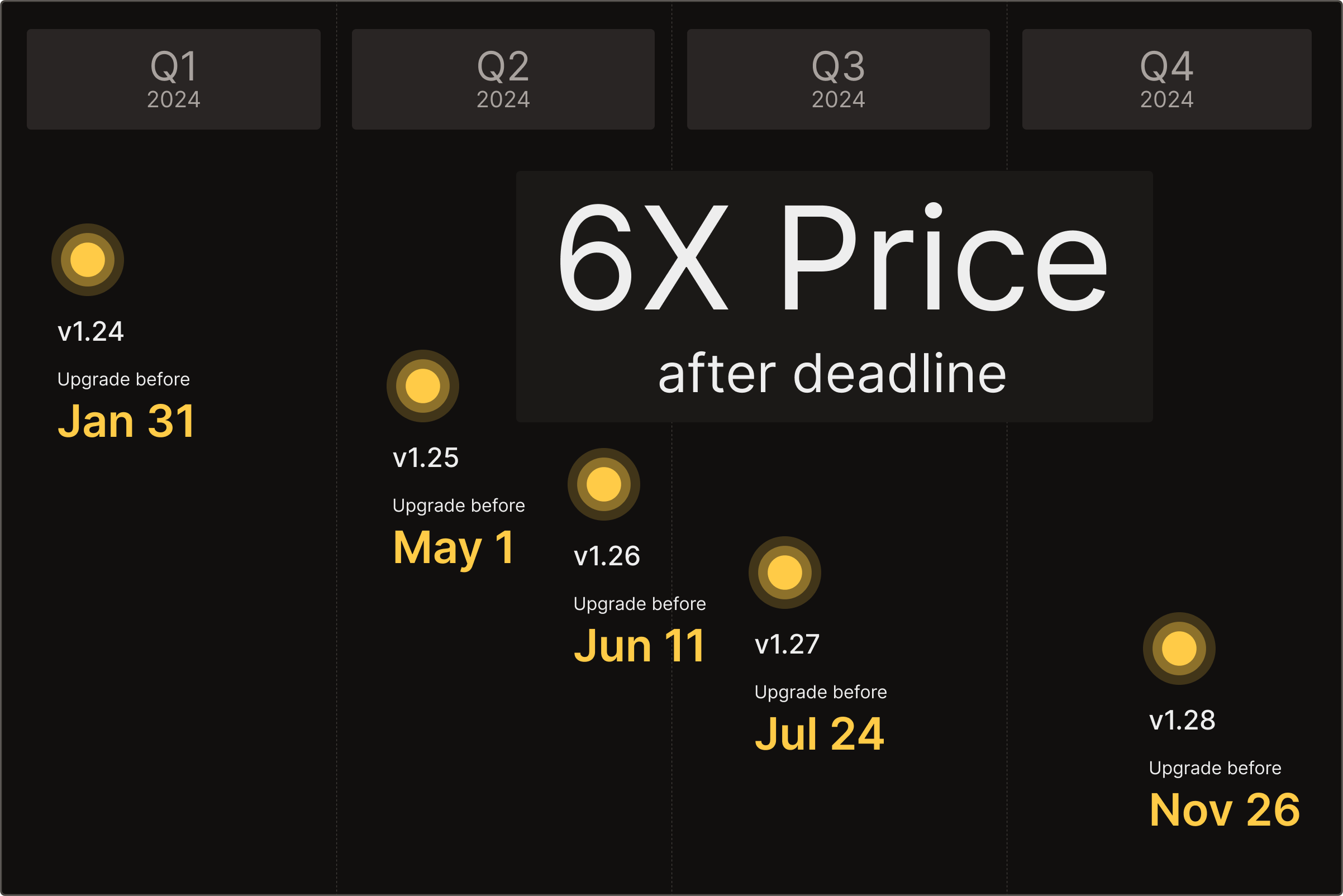
EKS and GKE both offer Extended Support for clusters running older Kubernetes versions. While the 6X surcharge for Extended Support may seem steep, there is a measurable and significant cost to backporting critical security patches and bug fixes in older Kubernetes versions—one that EKS and GKE take upon themselves. So, while upgrading Kubernetes clusters regularly can be painful, it is a necessary cost of adopting a vibrant, open-source-based compute orchestration system. But what happens if you fall behind and don’t upgrade your fleet, even during Extended Support?
Falling out of EKS and GKE Extended Support puts your clusters at risk of forced upgrades—an extreme, unavoidable, and disruptive event that threatens business continuity. When Extended Support ends, organizations have no choice but to rush an AWS EKS upgrade or to upgrade a GKE cluster, often leading to breakages and application failures.
While some enterprises have bought time by paying up to 6X in Extended Support fees for EKS and GKE, this only postpones the inevitable. The longer they wait, the harder the upgrade becomes. Kubernetes upgrades don’t have to be this painful, but without planning, forced upgrades will become a reality.
When enterprises delay upgrades for too long, they reach a point where even the EKS Extended Support or GKE Extended Support expires, leaving them with no option but to upgrade under pressure. These last-minute upgrades are untested, rushed, and highly disruptive. Organizations without a rollback plan often find themselves firefighting for weeks as they attempt to fix broken workloads. This could result in lost productivity, customer dissatisfaction, and substantial revenue losses.
The core problem with Kubernetes upgrades isn’t the control plane—it’s the vast network of addon dependencies. Enterprises run hundreds of addons, each with its own upgrade schedule, compatibility requirements, and hidden dependencies. Since many of these dependencies are undocumented, even a minor update can create a cascading failure across the system. Without proper tools to track dependencies, any GKE or EKS cluster upgrade is an unsafe operation, leaving teams scrambling to debug failures that should have been anticipated.
Note: Concerned about forced upgrades? Chkk can help you avoid them.
Kubernetes clusters rely on third-party Addons such as Istio, CNI plugins, monitoring tools, and ingress controllers. These Addons often break during upgrades due to version mismatches, but enterprises don’t realize it until development environments start failing. Because Addon compatibility isn’t standardized, teams must manually verify and test each Addon, further delaying the EKS upgrade or the GKE upgrade process. The inability to confidently upgrade Addons forces many organizations to delay Kubernetes upgrades indefinitely—until an impending forced upgrade leaves no other option.
Kubernetes regularly removes outdated APIs and features, requiring teams to refactor their code to maintain compatibility. Many enterprises fail to keep track of these deprecations, leading to unexpected failures when critical business workflows stop functioning after an upgrade in the dev environment. Without long range planning for upcoming API changes, organizations are blindsided by breaking changes that demand immediate engineering resources, further delaying the upgrade cycle and increasing the risk of EKS and GKE forced upgrades
Even when organizations commit to upgrading Kubernetes, the preparation work is exhausting. Teams spend weeks or months reading release notes, manually testing dependencies, and devising rollback strategies. This repetitive, tedious work drains engineering resources and pulls key personnel away from innovation and revenue-generating projects. With so much effort required, enterprises often delay upgrades until they are forced into a high-risk situation where they have no choice but to upgrade without full preparation.
Enterprises that attempt to avoid the complexity of upgrades by paying for EKS and GKE Extended Support find themselves burdened with skyrocketing costs. Cloud providers charge up to 6X the standard rate for Extended Support on outdated versions. While this may seem like an easy short-term solution, it only delays the inevitable, leading to higher costs in the long run. Businesses that continue delaying upgrades face mounting expenses from GKE Extended Support or EKS Extended Support fees, emergency patches, Kubernetes compliance risks, and operational inefficiencies.
Note: Are you already on GKE or EKS Extended Support? Chkk can help you upgrade in time, avoid extended support fees, and steer clear of forced upgrades.
Every day an enterprise continues running an older Kubernetes version, it increases its exposure to security risks. While EKS and GKE do a great job backporting security patches to older Kubernetes control planes and nodes, many open-source add-ons remain outdated and lack the latest protections—making them prime targets for ransomware, zero-day exploits, and data breaches. Cybercriminals know these versions are unpatched and specifically target them. Delaying upgrades is a dangerous game, as each passing day raises the likelihood of a catastrophic security event.
Regulations such as SOC 2, HIPAA, and GDPR mandate up-to-date security patches and system upgrades. Running older or outdated Kubernetes add-ons and dependencies puts enterprises at risk of non-compliance, opening them to hefty fines, revoked certifications, and reputational damage. Compliance auditors do not accept complexity as an excuse for failing to upgrade. Without a clear upgrade plan, businesses jeopardize their ability to meet regulatory requirements and maintain customer trust.
Older Kubernetes versions suffer from outdated features and incompatibility with modern tools. These inefficiencies slow down deployments, create bottlenecks in CI/CD pipelines, and make debugging significantly harder. Instead of innovating, engineering teams are stuck maintaining fragile, outdated systems that require constant patching and workarounds.
The longer an enterprise delays upgrading Kubernetes, the more expensive the problem becomes. Paying for Extended Support is just the beginning—businesses must also factor in the costs of emergency fixes, unplanned downtime, security breaches, and engineering burnout. Investing in proactive upgrade strategies is far more cost-effective than paying the long-term price of technical debt and forced upgrades.
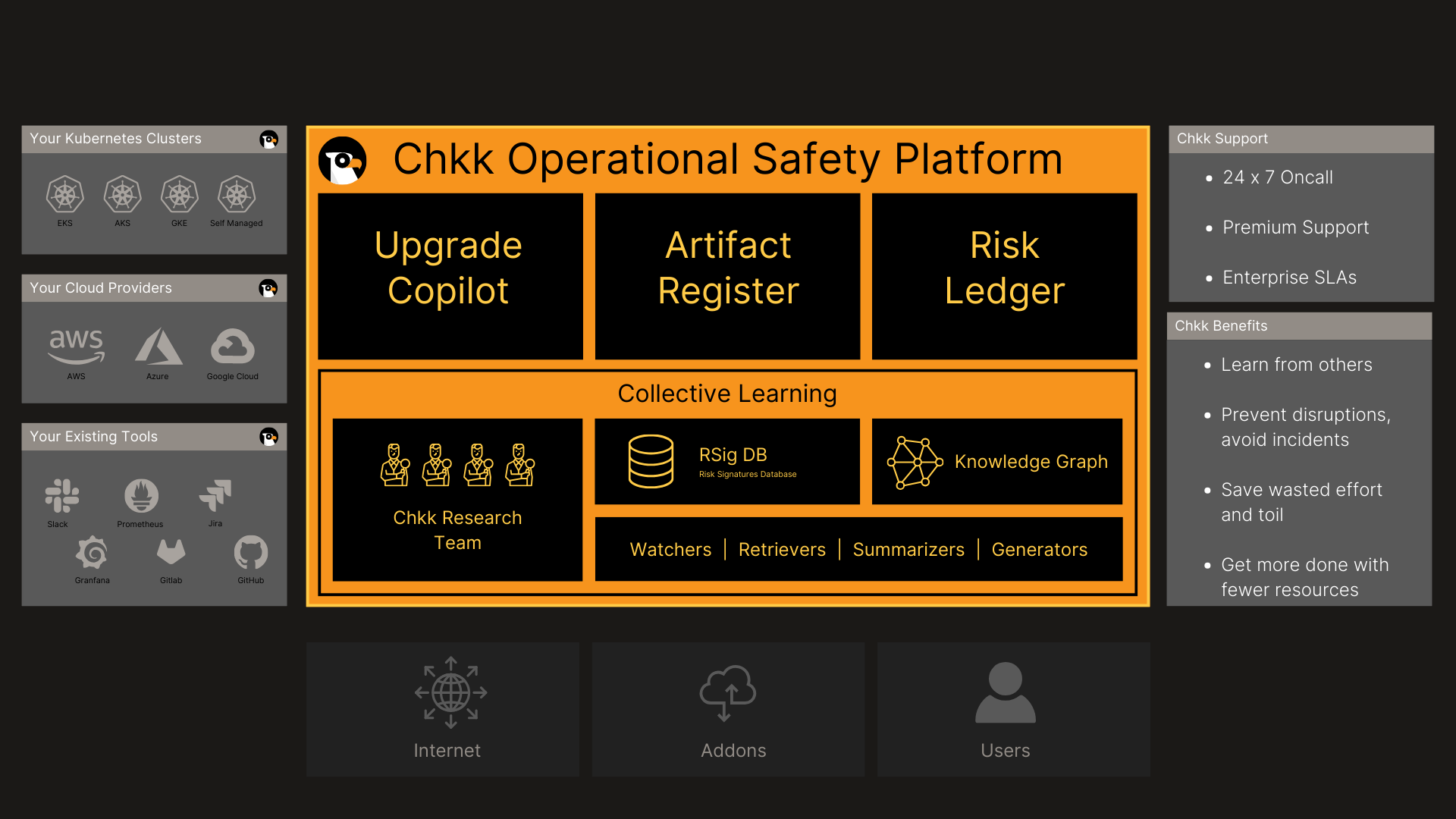
Organizations currently relying on EKS Extended Support and GKE Extended Support are at the greatest risk of a forced upgrade. Without a plan to address Addon dependencies, security risks, and compliance challenges, they are merely postponing the inevitable. Enterprises must take action now by investing in tools or vendors, such as Chkk, which specializes in Kubernetes Operational Safety and lifecycle management. Proactively upgrading Kubernetes is the only way to escape the risk of forced upgrades, unplanned disruptions, and skyrocketing costs.
EKS and GKE both offer Extended Support for clusters running older Kubernetes versions. While the 6X surcharge for Extended Support may seem steep, there is a measurable and significant cost to backporting critical security patches and bug fixes in older Kubernetes versions—one that EKS and GKE take upon themselves. So, while upgrading Kubernetes clusters regularly can be painful, it is a necessary cost of adopting a vibrant, open-source-based compute orchestration system. But what happens if you fall behind and don’t upgrade your fleet, even during Extended Support?
Falling out of EKS and GKE Extended Support puts your clusters at risk of forced upgrades—an extreme, unavoidable, and disruptive event that threatens business continuity. When Extended Support ends, organizations have no choice but to rush an AWS EKS upgrade or to upgrade a GKE cluster, often leading to breakages and application failures.
While some enterprises have bought time by paying up to 6X in Extended Support fees for EKS and GKE, this only postpones the inevitable. The longer they wait, the harder the upgrade becomes. Kubernetes upgrades don’t have to be this painful, but without planning, forced upgrades will become a reality.
When enterprises delay upgrades for too long, they reach a point where even the EKS Extended Support or GKE Extended Support expires, leaving them with no option but to upgrade under pressure. These last-minute upgrades are untested, rushed, and highly disruptive. Organizations without a rollback plan often find themselves firefighting for weeks as they attempt to fix broken workloads. This could result in lost productivity, customer dissatisfaction, and substantial revenue losses.
The core problem with Kubernetes upgrades isn’t the control plane—it’s the vast network of addon dependencies. Enterprises run hundreds of addons, each with its own upgrade schedule, compatibility requirements, and hidden dependencies. Since many of these dependencies are undocumented, even a minor update can create a cascading failure across the system. Without proper tools to track dependencies, any GKE or EKS cluster upgrade is an unsafe operation, leaving teams scrambling to debug failures that should have been anticipated.
Note: Concerned about forced upgrades? Chkk can help you avoid them.
Kubernetes clusters rely on third-party Addons such as Istio, CNI plugins, monitoring tools, and ingress controllers. These Addons often break during upgrades due to version mismatches, but enterprises don’t realize it until development environments start failing. Because Addon compatibility isn’t standardized, teams must manually verify and test each Addon, further delaying the EKS upgrade or the GKE upgrade process. The inability to confidently upgrade Addons forces many organizations to delay Kubernetes upgrades indefinitely—until an impending forced upgrade leaves no other option.
Kubernetes regularly removes outdated APIs and features, requiring teams to refactor their code to maintain compatibility. Many enterprises fail to keep track of these deprecations, leading to unexpected failures when critical business workflows stop functioning after an upgrade in the dev environment. Without long range planning for upcoming API changes, organizations are blindsided by breaking changes that demand immediate engineering resources, further delaying the upgrade cycle and increasing the risk of EKS and GKE forced upgrades
Even when organizations commit to upgrading Kubernetes, the preparation work is exhausting. Teams spend weeks or months reading release notes, manually testing dependencies, and devising rollback strategies. This repetitive, tedious work drains engineering resources and pulls key personnel away from innovation and revenue-generating projects. With so much effort required, enterprises often delay upgrades until they are forced into a high-risk situation where they have no choice but to upgrade without full preparation.
Enterprises that attempt to avoid the complexity of upgrades by paying for EKS and GKE Extended Support find themselves burdened with skyrocketing costs. Cloud providers charge up to 6X the standard rate for Extended Support on outdated versions. While this may seem like an easy short-term solution, it only delays the inevitable, leading to higher costs in the long run. Businesses that continue delaying upgrades face mounting expenses from GKE Extended Support or EKS Extended Support fees, emergency patches, Kubernetes compliance risks, and operational inefficiencies.
Note: Are you already on GKE or EKS Extended Support? Chkk can help you upgrade in time, avoid extended support fees, and steer clear of forced upgrades.
Every day an enterprise continues running an older Kubernetes version, it increases its exposure to security risks. While EKS and GKE do a great job backporting security patches to older Kubernetes control planes and nodes, many open-source add-ons remain outdated and lack the latest protections—making them prime targets for ransomware, zero-day exploits, and data breaches. Cybercriminals know these versions are unpatched and specifically target them. Delaying upgrades is a dangerous game, as each passing day raises the likelihood of a catastrophic security event.
Regulations such as SOC 2, HIPAA, and GDPR mandate up-to-date security patches and system upgrades. Running older or outdated Kubernetes add-ons and dependencies puts enterprises at risk of non-compliance, opening them to hefty fines, revoked certifications, and reputational damage. Compliance auditors do not accept complexity as an excuse for failing to upgrade. Without a clear upgrade plan, businesses jeopardize their ability to meet regulatory requirements and maintain customer trust.
Older Kubernetes versions suffer from outdated features and incompatibility with modern tools. These inefficiencies slow down deployments, create bottlenecks in CI/CD pipelines, and make debugging significantly harder. Instead of innovating, engineering teams are stuck maintaining fragile, outdated systems that require constant patching and workarounds.
The longer an enterprise delays upgrading Kubernetes, the more expensive the problem becomes. Paying for Extended Support is just the beginning—businesses must also factor in the costs of emergency fixes, unplanned downtime, security breaches, and engineering burnout. Investing in proactive upgrade strategies is far more cost-effective than paying the long-term price of technical debt and forced upgrades.
Organizations currently relying on EKS Extended Support and GKE Extended Support are at the greatest risk of a forced upgrade. Without a plan to address Addon dependencies, security risks, and compliance challenges, they are merely postponing the inevitable. Enterprises must take action now by investing in tools or vendors, such as Chkk, which specializes in Kubernetes Operational Safety and lifecycle management. Proactively upgrading Kubernetes is the only way to escape the risk of forced upgrades, unplanned disruptions, and skyrocketing costs.



.png)


.png)

.png)








.png)



.jpg)